A Tasmea Ltd. Thesis
The Dynamics Set to Move the Stock

Tasmea Ltd. ($TEA.AX) has no shortage of business characteristics that continuously lead to execution and outperformance in the setting of a relatively safe and visible business environment. Founder led and owned, great historical growth, talented operators, good balance sheet, industry tailwinds, a series of moats, etc. Frankly, the company is a pleasure to research. There are deep dives around, including my own past writings, that can fill you in on most of it. But what I want to answer today is a question specifically about the core thesis. What is it that will make the stock price move up, or better yet, compound? Stock price chases cash generation. We all know that. I want to know the mechanics that will usher Tasmea’s cash flows north. That is the topic of this article.
The Growth Moat
First, let’s talk through the types of growth the business is experiencing, and how they affect the quality of the business.
Tasmea has two growth vectors which both contribute to the thesis– organic and inorganic (acquisitions). Organic growth is as you’d expect; Tasmea and its subsidiaries are able to bring on more industrial clients through master service agreements. The services offered are critical in nature, in high demand, and function within growing TAMs. All of this plays a part in the thesis as it relates to organic growth.
However, the most interesting aspect of the business comes from inorganic growth. Not because they are able to acquire companies and plug their earnings into the consolidated picture without erasing shareholder value- though that’s certainly important- but because these acquisitions serve as an unlock for the organic side’s potential. That’s the real power behind the strategy. Let me explain.
When Tasmea acquires a company, they expand their ability to sell even more services to clients. This is a boon for growth in 3 ways.
Existing clients find efficiency and convenience in using Tasmea as a one-stop-shop for multiple required services, as Tasmea’s expertise spans a wider breadth. Clients no longer have to piece their needs together from multiple players. This is a competitive edge for Tasmea, and may even translate as one for the client as they offload service complexities.
Tasmea becomes more attractive to new clients who are making considerations about who they will sign MSAs with. Tasmea can simply do more for them than the competition, and so they become the go-to option. Again, a competitive advantage.
Acquisitions of new businesses let Tasmea grab a footprint in new areas where the newly acquired subsidiary business exists. The new footprint acts as a gateway for selling services to potential clients in the new region. Tasmea then comes in with all of its available services and expertise, looking attractive to clients in the sheer breadth of what they can do. Often, and by design, these are often in remote areas with low competition. Yet again, we see another moat form from growth.
One for one, the acquisitions take the subsidiary’s earnings and bring them into Tasmea’s income statement. That’s the inorganic growth, but that’s only the start. The synergies above are what’s important, highlighting just how well these acquisitions can also serve to ramp Tasmea’s ability to organically grow. All the while, each acquisition adds to Tasmea’s offerings and subsequently piles onto their growing stack of competitive advantages. And according to management, there are plenty of acquisitions to be had that would be value accretive to Tasmea’s vision.
“Every time we buy, we create shareholder value. We’ve got a strong pipeline of opportunities that are currently under consideration, and most importantly, we’ve got the balance sheet strength to and the funding to continue to grow programmatically.”
– Stephen Young, CEO
Labor Strength as a Contract Winner
Competitive advantages for Tasmea are not built on acquiring alone. The recent WorkPac acquisition means that Tasmea has a unique ability to solve labor shortage problems where competitors cannot. WorkPac is the largest contractual labor provider in Australia, and now Tasmea controls that labor. This means that they can grab expertise from that labor pool at will and deploy it quickly. This is yet another competitive advantage for Tasmea since many contracts can be won simply from having the labor available to do the job quicker than other businesses can wrangle the labor to make it work. With Tasmea’s labor pool, there is no waiting, which is an especially attractive prospect during an unplanned shutdown, as an example. Again, this leads to a future of continued organic growth as Tasmea can do the work quickly and properly. The massive skilled labor pool that is now available to and controlled by Tasmea goes straight onto the pile of competitive advantages for continued organic growth.
Rising Tides
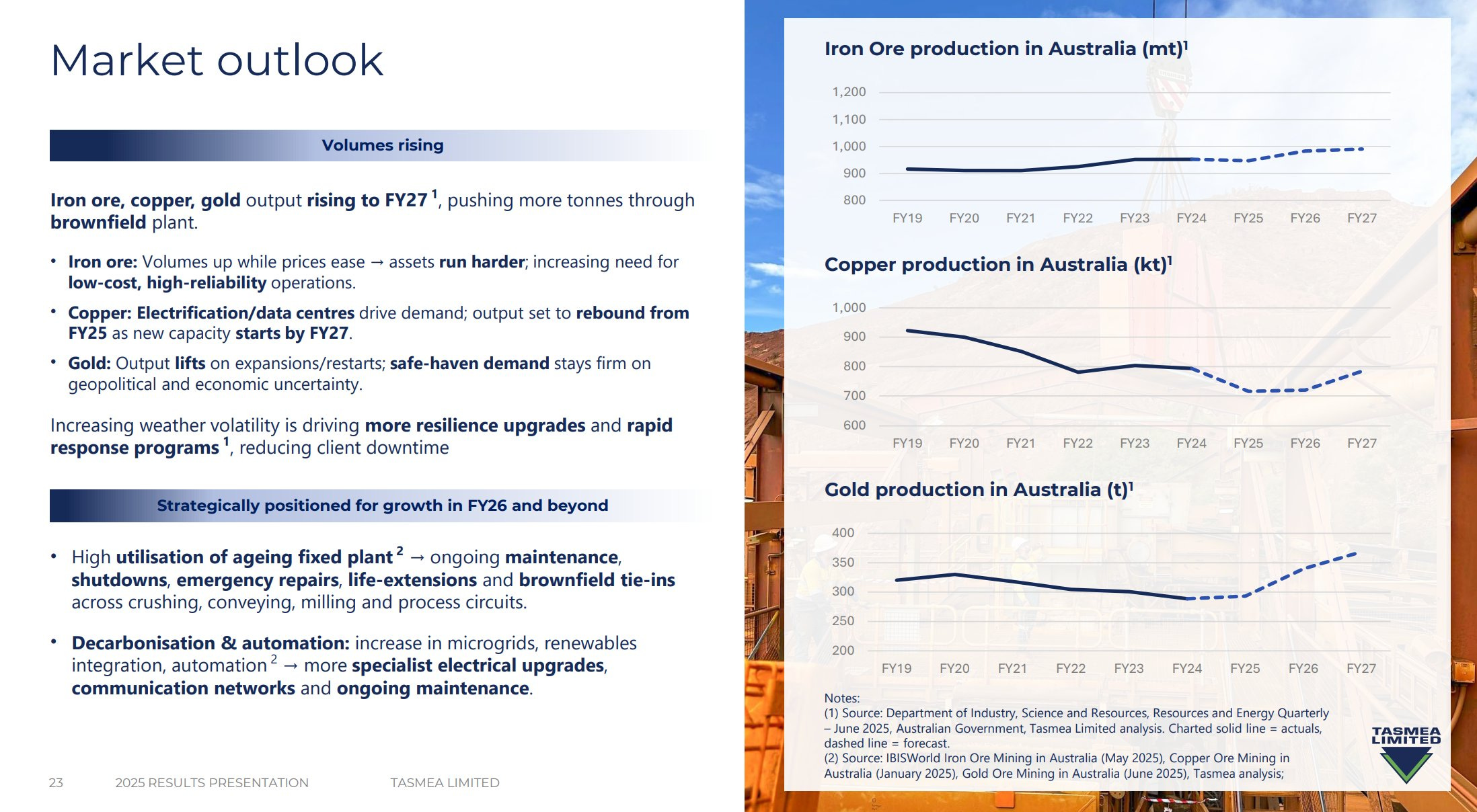
All of this company growth takes place in a TAM that itself is growing. When you have the best and most complete service offerings, that advantage alone means the company will likely do well. But when you operate that way in a total addressable market that is acting as a tailwind for the whole industry, that effect is especially potent on the best in class operators. The growing TAM takes the whole thesis and sets it atop a rising tide.
“No matter what’s happening politically here, that electrification trend, in my view, will stay. If I had a comment about the target, if anything, it’s so large, it’s unachievable.”
-Stephen Young, CEO
Marginal Outperformance
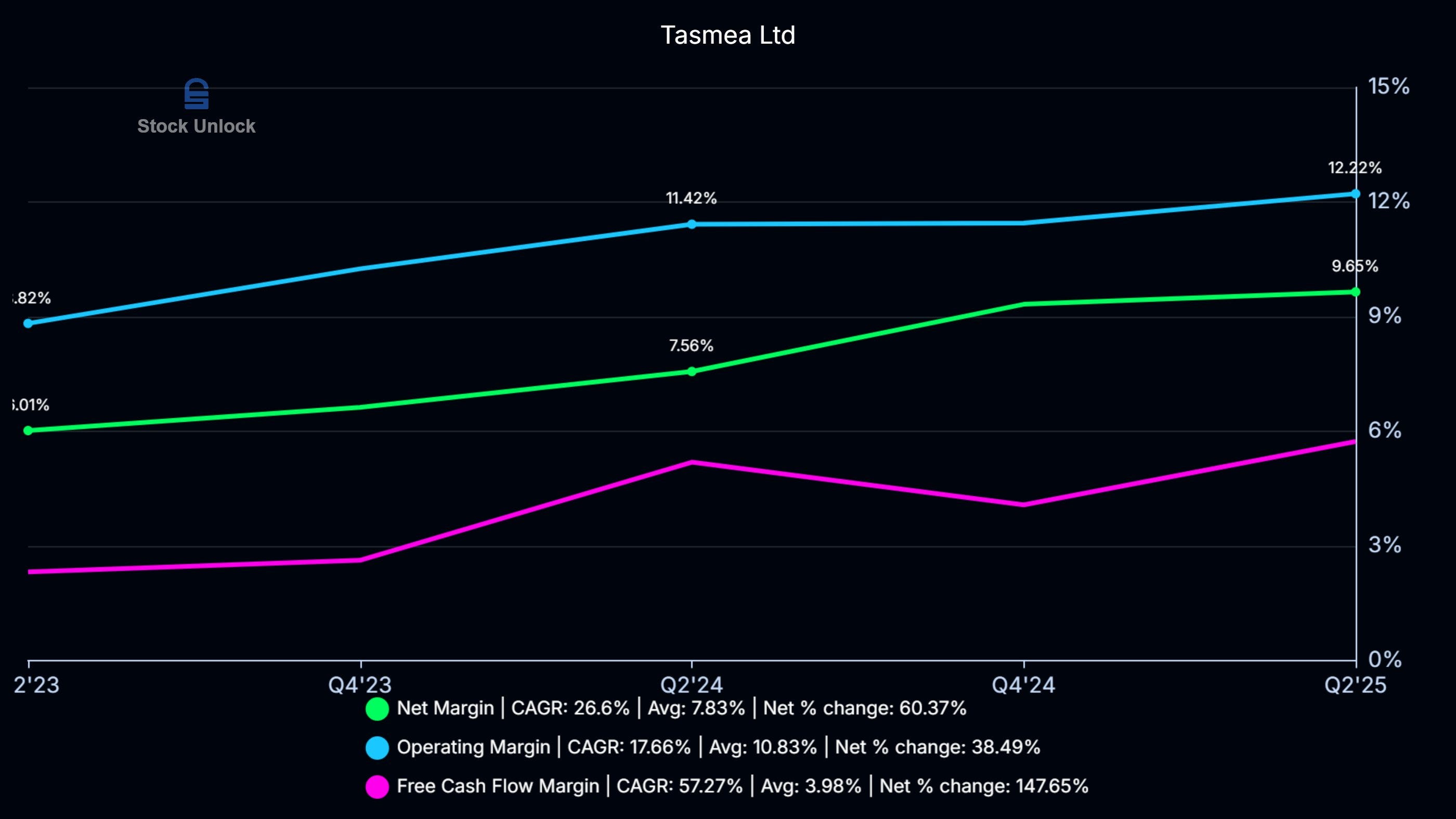
Tasmea has been enjoying the sight of its margins ascending up-and-to-the-right for years now. This is largely a product of the organic unlock stemming from acquisitions that I mentioned before. Tasmea used to take on MSAs (master service agreements) and would have to outsource parts of the job that they had no specialization in. This was costly to the bottom line. As new subsidiaries and new service abilities were brought within the ecosystem, Tasmea needed to do this less and less. Self-servicing aspects of the job that they weren’t able to before means that a large expense becomes a money-maker instead. The inorganic acquisition model naturally brings margins upward in this way, which is why the management is so focused on making sure every acquisition works to expand their specialist capabilities. The new business has to fit.
Struggles with labor shortages were another margin suppressor that Tasmea has wrestled with. In order to secure a service contract and get the job done quickly, safely, and correctly in the face of a labor shortfall, Tasmea got used to spending towards the upper end of what was appropriate for the contracted skilled labor needed in the moment. The goal was to entice the right people to come in Tasmea’s direction rather than electing to go somewhere else. Again, this was expensive, and costly to the bottom line. This issue has been largely solved by the WorkPac acquisition. As Tasmea pulls from their new skilled labor pool at will, margins will thank them. We have not yet seen the effects on margins that WorkPac will bring.
The newly acquired labor synergies and continued new service offerings coming from future acquired companies will see that these margin expansion trends continue. We originally set out to talk about the thesis– the things that will see the stock price grow and compound. Stock prices eventually follow cash generation, and as margins expand, growth in cash generation will outpace growth in revenues. That is how Tasmea’s management has designed the effects of scale on their business.
Margins show a picture of strength as a byproduct of well-designed scale.
And Finally, Valuation
Depending when you read this, the valuation may shift around. However, as it stands today, there is a substantial margin of safety. Stock price recalibration towards a fairer multiple alone will reveal decent gains. The business, and the stock price along with it, should compound from there.
Tasmea’s management is guiding towards $0.30 AUD in earnings per share, which translates to a 30% increase in EPS for 2026. However, that doesn’t include any synergies, which are many, from their latest acquisition of WorkPac, or anything extra from any potential acquisitions this year.
Modeling EPS over the next 5 years at growth rates of 30% (guidance for 2026), 25%, 20%, 15%, and finally 12% for each year to 2030, gets us an EPS of $0.58 AUD. In my view, this model is likely too conservative, which serves as an inherent margin of safety.
Assume a PE of 15 → $8.7 AUD/share, which gets us a 15.8% CAGR return, on our margin of safety low-end estimate, from today’s price of $4.18.
At a PE of 18, which falls more in line with competition, we would see $10.44 AUD/share, bringing us to a CAGR of 20% on our money today.
This is all from a base case of $0.30 EPS in 2026, which is guidance that is very likely to be handedly beaten. The potential upside is very healthy.
Final Thought
It’s rare to find a business of this quality that so few are talking about. Perhaps this plays a part in today’s stock price. After studying the company’s inner dynamics, the economics behind the business and the qualities that come streaming from their expansions, we can see a real thesis form– one that is likely to move the stock price over time. The blueprint has been constructed, the machinery set in place. All that’s left is for the management to turn the gears. And they have a great track record of doing exactly that.
Not financial advice.